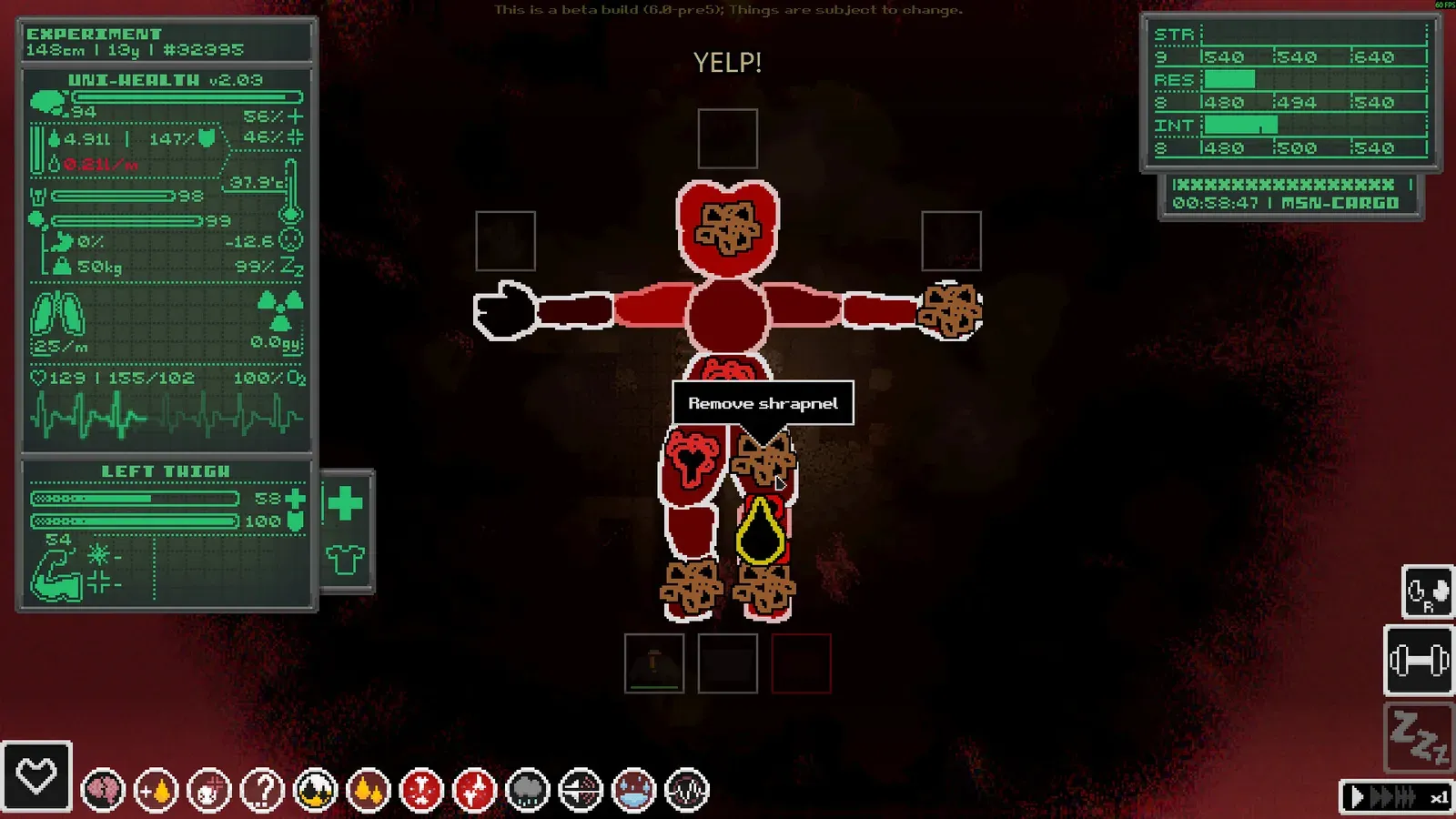
Most Casualties: Unknown deaths are not one big mistake. They are a small wound that was not checked, a bandage applied too late, or an infection that became sepsis while the player was looking for loot. This guide explains the actual thresholds and gives you a treatment order you can use in the dark.
The 30-second triage order
When you open the health panel after a fight, do not start with the wound that hurts most. Start with the one that will kill you first. The game models blood loss, consciousness and infection on separate clocks, so the correct order is:
- Stop catastrophic bleeding. A limb losing more than roughly 0.3 L/m needs a Tourniquet immediately, especially if blood volume is falling.
- Protect consciousness and breathing. If consciousness is dropping, treat pain and blood loss before anything else. A head or thorax wound takes priority.
- Bandage the wound. Apply a Dressing to reduce bleeding and restore skin health. Do not leave a tourniquet on as the final treatment.
- Disinfect. Clean the limb before infection sets in. Glowplant Fruit is the early option; antiseptic is better.
- Splint bones. Fractures and dislocations are not immediately fatal, but they will be if you need to run.
- Manage pain and monitor. Pain above 75 builds shock. Treat it, then re-check infection and temperature.
The injury triage tool automates this order from four inputs. Use it if you are panicking; the guide explains why the order works.
Bleeding, by the numbers
Each limb tracks bleeding as a value from 0 to 100. That value is capped by the limb’s missing skin health: at 80 skin health, the limb can only bleed up to 20. Each bleeding point converts to 0.015 L/m, so a full 100-point bleed is 1.5 L/m at neutral blood viscosity and up to 3 L/m at -100 viscosity.
Blood volume normally sits at 5.00 L. It regulates back toward that value faster when you are well fed, but it can fall to zero. Low volume lowers blood pressure, raises heart rate and pushes you toward fibrillation at 200 BPM. Bleeding also raises infection chance, so a “small” wound is never only a blood-loss problem.
| Bleeding sign | Rough rate | First action |
|---|---|---|
| Minor smear, stable volume | Under 0.1 L/m | Dressing when safe; disinfect if the wound is dirty. |
| Steady drip, volume falling slowly | 0.1-0.3 L/m | Dressing now. Tourniquet only if you cannot stop it. |
| Heavy flow, volume falling fast | 0.3-0.7 L/m | Tourniquet first, then move to safety and bandage. |
| Spurting or near-instant loss | 0.7 L/m+ | Tourniquet immediately. Blood loss is the emergency. |
Tourniquet rules
The Tourniquet stops all bleeding on a limb instantly and has eight uses. It adds 2 limb pain per second up to 40, and after nine minutes it damages the muscle below it and can seed infection at 10% progress. Remove and reapply before the timer expires if you still cannot bandage the wound.
Do not put a tourniquet on the head; it causes respiratory arrest. It cannot be applied to the thorax or abdomen. If a limb is amputated, any tourniquet on it is removed automatically.
Dressing efficiency
A Dressing provides 12 wraps. Each wrap removes 0.05625 L/m of bleeding over three seconds, restores 2.5 skin health over five seconds, removes 5 limb pain and speeds fracture healing by 38.8 seconds. A full dressing removes 0.675 L/m and restores 30 skin health.
Because Dressings weigh 0.9u, the efficient play is to carry Canvas and craft Ripped Dressings at the health panel. Two Ripped Dressings make a full Dressing at INT 5. If you have a Material Pouch, Canvas becomes even lighter.
Infection and immunity
Infection is a hidden second clock. A limb with skin health below 80 rolls for infection every 40 seconds: the base chance is 23% × (1 - skin health / 80), increased by bleeding. At 60 skin health the chance is about 5.75%; at 20 it is 17.25%. The game’s infection chance run setting is inverted in Demo 7.0.1, so lowering it actually increases infection risk. Leave it at 1×.
Once infected, a limb gains 7.2 infection progress per minute at 100% immunity. Low immunity accelerates it; high immunity can halt or reverse it. Disinfection subtracts 1.7 from the rate multiplier, which is why cleaning a wound early matters so much.
- Infection above 75 drains muscle health at 0.2 per second.
- Infection above 90 spreads to adjacent limbs.
- Total infection above 100 starts sepsis.
- Above 60 most cutting tools can amputate the limb.
- Sickness at 95 instantly infects the abdomen.
- Tourniquet over nine minutes seeds infection in the affected limb.
What actually raises immunity
Antibiotics, Antiserum and Ceftriaxone raise immunity. So does being healthy: high satiation, hydration and energy, low dirtiness, low sickness and low radiation. Radiation lowers immunity by 5/3 per Gy, which is why the Wasteland turns small wounds into disasters.
The Antibiotics Bottle is the practical choice: 20 mL reduces sepsis by 5, raises immunity for 8m 20s and costs only 1 mood. The Ceftriaxone Syringe gives a longer immunity window but adds pain without adrenaline, so it is easier to sell than to use.
Pain and consciousness
Total pain is based on your highest limb pain, reduced by adrenaline and Resilience. It is not just a debuff: it directly caps consciousness at 150 - total pain. At 80 pain, your consciousness cannot exceed 70%. At 100 pain, it cannot exceed 50%.
- Above 31 pain: you cannot sleep, and you wake up if already asleep.
- Above 50 pain: mood drains and trauma builds.
- Above 75 pain: pain shock builds at 3.33% per second. At 66% shock you pass out - roughly 20 seconds.
- Above 99 pain: immediate ragdoll.
Adrenaline halves pain and buys you a window to escape. It is not a treatment. The Combat Pen is the strongest emergency option: it numbs pain, restores stamina and consciousness, and can restart a stopped heart. Use it to reach safety, then treat the cause.
Resilience reduces total pain by 2.5% per level above 10. At 11 Resilience, pain cannot reach 100, so you cannot ragdoll from pain alone. At 20, pain cannot exceed 75, which prevents pain shock entirely. That is one of the strongest long-run arguments for training Resilience.
Fractures and dislocations
Bones are a mobility problem before they are a health problem. A fractured leg slows movement, adds pain and makes every jump a risk. A dislocated limb is worse until it is reduced. The Splint sets limb strength to zero while worn, but multiplies fracture healing by 2.5 and dislocation healing by 2, and lasts about 66 minutes.
Splint before you climb, not halfway up. If you must move with a broken leg, crouch-walk, avoid falls and use walls to slide. The Carcass Splint is a lighter makeshift option but decays much faster. The Bone Welding Tool can fix fractures but does not handle dislocations.
Sepsis and amputation
Sepsis begins when total infection across the body exceeds 100. It rises by total infection × infection speed × 0.028 every second, and it lowers blood pressure by 0.4 per point. Above 80 sepsis, fibrillation is almost guaranteed, followed by death if untreated.
Treatment is to reduce total infection below 100, use antibiotics or antiserum to lower sepsis directly, and support blood pressure with Vasopressin if you have it. Amputation is the last resort for a limb above 60 infection. It removes all infection from the connected limb and disinfects it for five minutes, but causes severe bleeding, pain and permanent loss of the limb’s inventory slot or mobility.
A worked example
A Sand Stalker hits your right thigh in the Dried Desert. The health panel shows 68 skin health, 0.18 L/m bleeding and 62 limb pain. You have a Tourniquet, one Dressing, a Glowplant Fruit and no antiseptic.
- Move first. Break line of sight. The stalker is faster than you; fighting it with a bleeding leg is how the run ends.
- Check the rate. 0.18 L/m is significant but not catastrophic. A Dressing can handle it; a tourniquet is optional if you are safe.
- Bandage. Apply the Dressing to the thigh. Stop when the bleeding icon fades, not when the bar is empty.
- Disinfect. The wound came from an enemy with a 20% infection chance. Apply the Glowplant Fruit. It costs 10 pain and a little muscle health, but 220 seconds of disinfection is worth it.
- Monitor. Re-open the panel in a minute. If bleeding resumes, bandage again. If pain is above 75, treat it before it causes shock.
- Plan the infection. Without antibiotics, keep the limb clean and avoid further damage. A Rose Light can reveal infection early; a doctor’s visit is not an option.
The medical kit
A practical mid-game kit weighs less than you think if you carry materials instead of finished items:
- 1 Tourniquet (0.2u) - instant bleed control, eight uses.
- 4-6 Canvas (0.1u each) - craft Dressings on demand.
- 1 Antibiotics Bottle (0.3u) - infection and sepsis management.
- 1 Splint (1u) - fractures and dislocations.
- 1 Glowplant Fruit (1u) - light and emergency disinfection.
- 1 Painkiller or Combat Pen - only if you expect a fight you cannot avoid.
The rest is knowledge. Check the panel after every encounter, treat bleeding before pain, and never let a dirty wound wait for a convenient moment. If you want the layer-specific risks, start with the Dried Desert and Wasteland pages; those are where infection and radiation stack.